

O MAVEN, Where Art Thou? Impacts from MAVEN’s Anomaly.


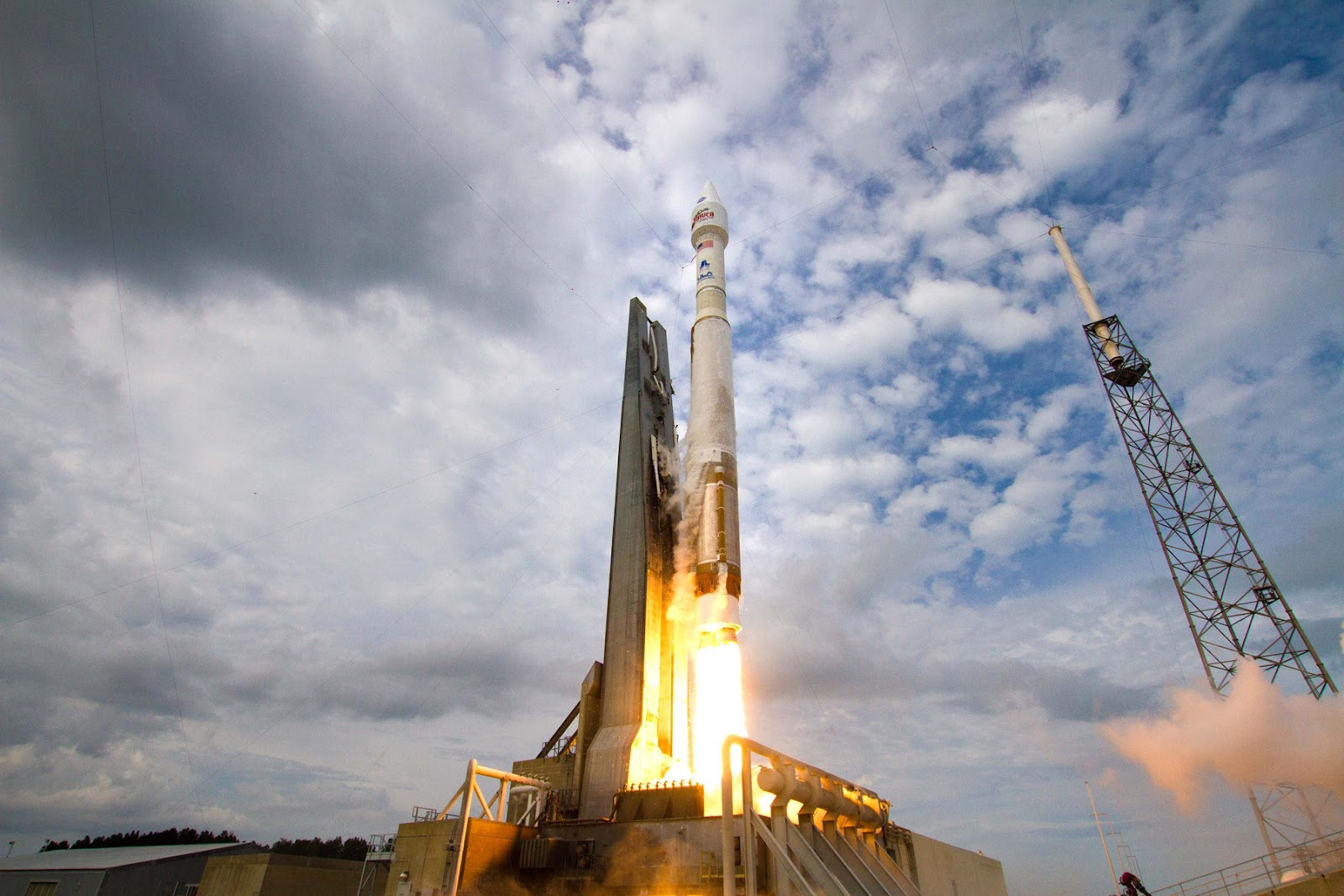
While it is easy to assume everyone in our little space community is familiar with MAVEN, let's take a moment and get everyone up to speed on just what MAVEN is. MAVEN is short for The Mars Atmosphere and Volatile EvolutioN satellite.The MAVEN satellite was a collaboration between the University of Colorado Boulder / Laboratory for Atmospheric and Space Physics (LASP), the University of California, Berkeley / Space Sciences Laboratory (SSL), and NASA’s Goddard Space Flight Center (GSFC). Lockheed Martin served as the ultimate contractor to assemble MAVEN, and the spacecraft was launched on November 18, 2013 from the Cape Canaveral Space Force Station. It made its voyage into space on top of a United Launch Alliance Atlas V rocket in the 401 Configuration.
Dude, Where’s my Atmosphere?
MAVEN’s main purpose is to study the upper Martian atmosphere, and determine how it is being eroded by solar winds and radiation. At the start of its mission, the main goals were to look at the atmosphere’s current state, the processes controlling it, and the relationships to the atmosphere’s escape rate. Ultimately, everyone involved with MAVEN wanted to establish a picture of what happened to the Martian atmosphere over time. Why? In the past, it is believed, the Martian planet and atmosphere were much like Earth’s, so understanding long-term atmospheric erosion on Mars could give us a better understanding of the same phenomenon on our home planet. Essentially, you can think of MAVEN as a Martian climate change satellite.
While this has remained MAVEN’s main focus while orbiting Mars since 2014, it has studied many other aspects of the Martian planet. From detecting the Martian Aurora to observing massive solar storms hitting the thin Martian atmosphere, MAVEN has served to help astronomers and scientists have a much better understanding of both what is going on with the Martian atmosphere today, and where it went eons ago.
MAVEN also serves as an important component in the Mars Relay Network.
The MAVEN Timeline
Launched on November 18, 2013, MAVEN began its 10 month trip to intercept Mars and begin its primary mission. Orbital insertion happened on September 22, 2014. After multiple burns to adjust its elliptical orbit, MAVEN was ready to begin studies on the atmosphere and planet.
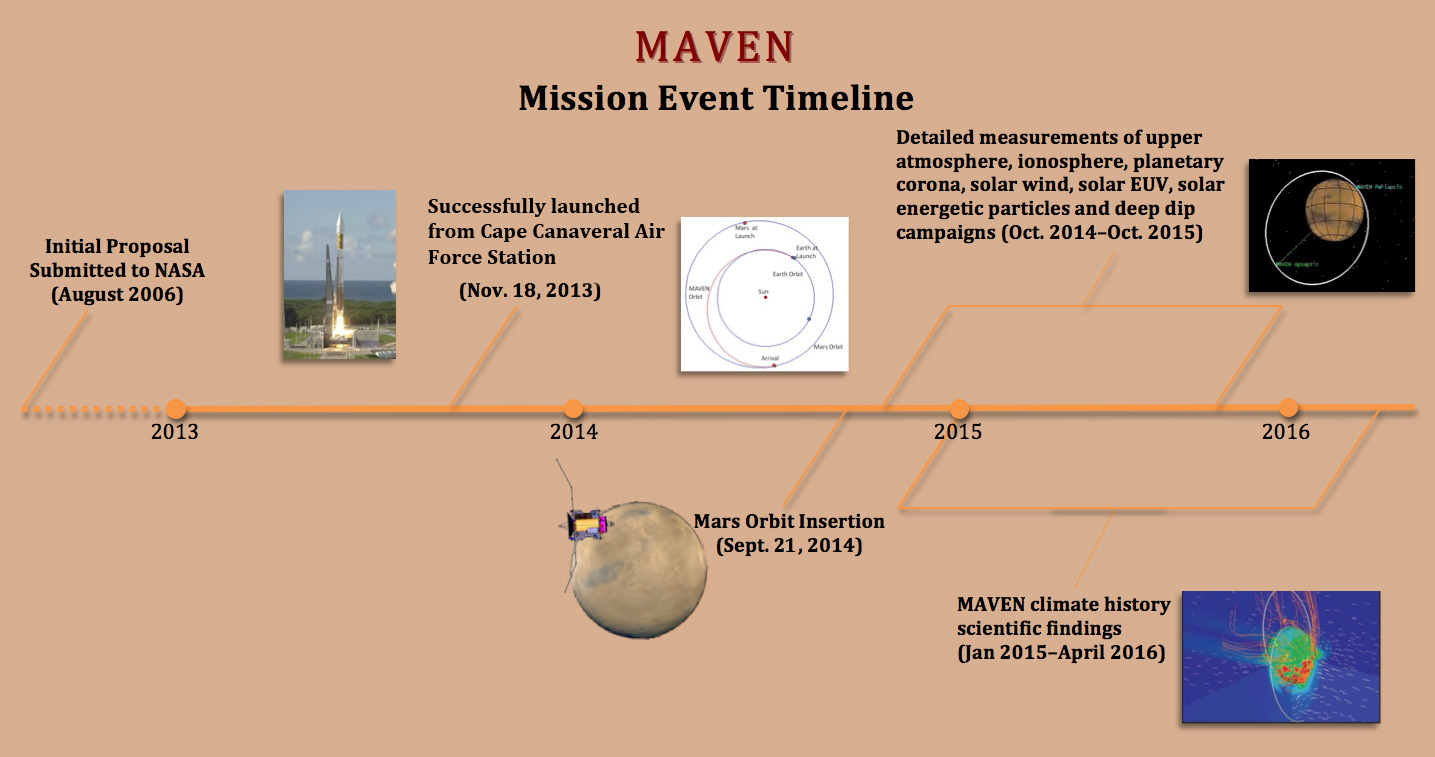
MAVEN’s planned mission duration was supposed to last into 2015. This wasn’t due to fuel or power limitations, but more due to the original mission plans for MAVEN. Its first mission extension was from November 2015 to September of 2016. Beyond this time, as we know today, MAVEN has seen multiple mission extensions throughout its lifespan. The most recent extension was in April of 2022, with MAVEN extended through September of 2025. Although the MAVEN program was on the governmental chopping block in 2025, it was ultimately extended once again.
This timeline brings us to December 6, 2025 and the loss of signal with the MAVEN satellite.
What Happened and the Impact
MAVEN has a very elliptical orbit, which takes it behind Mars on a trajectory where NASA loses communication with the Satellite for a period of time. As MAVEN was supposed to emerge from the back side of Mars on December 6, the NASA Deep Space Network failed to detect its expected signal from MAVEN. On December 9, NASA issued a press release explaining the loss of contact with the satellite. This release highlighted the hope of regaining communication with MAVEN in the coming days. In a second release on December 15, NASA explained the attempts to reach the ailing satellite and how a single telemetry signal on the 6th showed MAVEN was rotating in an unexpected fashion as it emerged from the back side of Mars. So far, attempts to establish contact with both the Deep Space Network and the Mars Relay Network have failed.
What isn’t clear, at this point, is what happened on the back side of Mars. While speculation abounds, several probable possibilities exist. Could it have been hit by an asteroid or some other space object? Was there an uncommanded thruster firing or some other problem with the MAVEN hardware? It could be a while before anything is known, if ever. MAVEN has proven to be a very robust satellite, but it did have gyroscope failures in 2022, which forced the satellite team to push a new star tracking system to MAVEN.
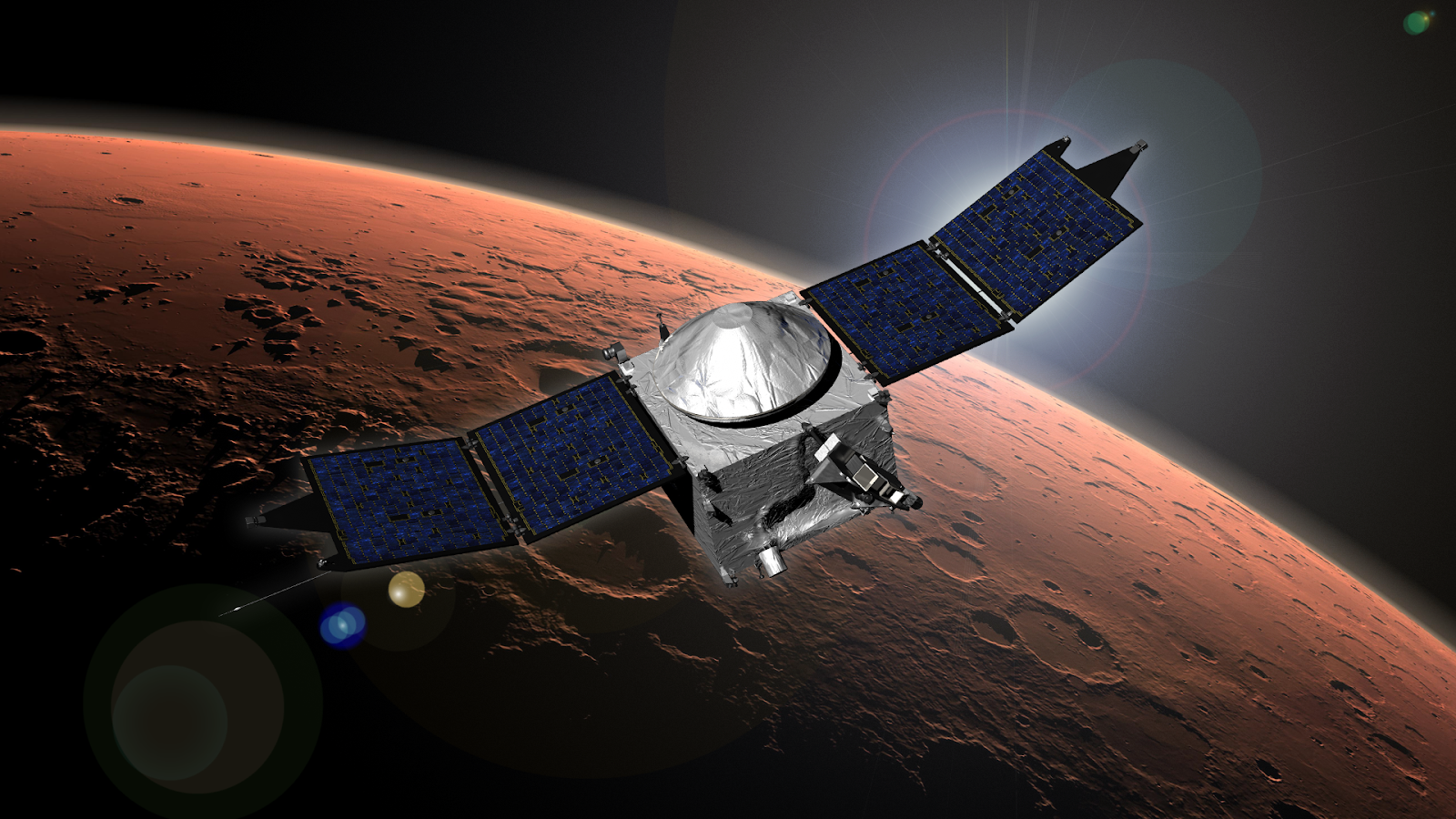
The ultimate impact of the loss of MAVEN is much bigger than just the atmospheric data loss. MAVEN was one of 5 satellites which make up the Mars Relay Network. This network is used to communicate with the Perseverance and Curiosity rovers on the planet's surface. With MAVEN’s anomaly the planning and use of both rovers has changed dramatically. Of the 4 remaining satellites, 2 belong to NASA and 2 belong to the European Space Agency (ESA). One of NASA’s satellites, the Mars Odyssey orbiter, is 24 years old and is essentially running on fumes. With its loss the use of the two rovers will change once again.
Mars is expected to start conjunction with the Sun around January 9, 2026. All communication with Mars will be lost for multiple weeks. If communication with MAVEN doesn’t take place before then the satellite may be lost for good.
No matter the outcome, MAVEN has been a total success for the teams who created it. Its loss will definitely hinder operations on the Mars surface, but it has served its post well. Here’s to hoping NASA can get a signal to the ailing satellite before it's too late.
Want to learn more about MAVEN? The University of Colorado’s MAVEN website is a great place to start: https://lasp.colorado.edu/maven/
0 Comments