

NASA "Ignition" Event Details the Next Decade's Most Exciting and Revolutionary Missions


With a clarity of vision not seen since the days of Apollo, on Tuesday, March 24th 2026, NASA Administrator Jared Isaacman, along with several deputy administrators and heads of program areas at the space agency, presented “Ignition: A Vision of Space and Lunar Exploration.” Unlike previous efforts, this isn’t a vision of the future, but one that NASA’s beginning work on immediately.
NASA confirmed that the Space Launch System will no longer use the Interim Cryogenic Propulsion Stage after Artemis 3, and will switch to the Centaur V from ULA’s Vulcan rocket going forward. The ICPS may fly for the last time on Artemis 2, as NASA has not yet decided if Artemis 3 will use the stage for the recently added Low Earth Orbit demonstration mission. The Artemis 3 mission has been redesigned to reduce as much risk as possible ahead of crewed lunar surface missions. Major goals include demonstrating multi-launch campaigns for the landers and the Orion capsules, rendezvous and docking, crewed operations with all spacecraft and validation of performance for all vehicles.

One pain point mentioned by Isaacman was that Artemis 2 has repeated some of the same ground system issues seen on Artemis 1, and NASA wants to be sure those issues are resolved by the time Artemis 3 launches. It’s also not clear at this time which Human Landing System will actually fly the Artemis 3 mission, with SpaceX’s Starship and Blue Origin’s Blue Moon lunar landers both progressing toward the same goal.
Like many of the things covered in the Ignition event, most of the timetables and approaches are in flux, and design studies are underway to decide how these missions will be executed. Either Starship or Blue Moon may end up flying the Artemis 3 mission, or possibly even both. After the initial testing of the Artemis landers, NASA will be conducting a major, strategic operational pivot. The agency has developed a three-phase plan, culminating in the construction of a permanently occupied moon base. There will be at least one landing each year starting in 2028, with post Artemis 5 landings every six months, and potentially higher cadence as the systems and capabilities improve. NASA began phase 1 on Tuesday, with requests for proposals for lunar surface access and scientific experiments. Phase 2 calls for an initial lunar base operating capability, beginning in 2029, and phase 3 results in a semi-permanent crew presence, starting in 2033.

This ambitious plan, with an expected cost of over thirty billion dollars over the next ten years, requires a multitude of contributions from industry, university and private partnerships, with future openings for new lunar lander suppliers and additional commercial lunar service providers. Mission plans already in the works include development of navigation capabilities, communication and observation satellite constellations, high bandwidth lunar surface communication towers, “Viper” lunar resource prospectors and “Moonfall” drones, designed to hop across the lunar surface and scout hard to reach terrain. Additionally, radioisotope heating units (RHUs) are needed to help electronics survive the night, radioisotope thermoelectric generators (RTGs) will be necessary for surface power and Lunar Terrain Vehicles that can survive lunar night will be necessary to sustain a human presence on the moon.

The Gateway program is also being put on hold because the orbital lunar outpost doesn’t directly aid in getting to the lunar surface. Moreover, insertion into the near-rectilinear halo orbit where Gateway was intended to reside requires 10 to 20% of the delta-v margins of the landers, and both Blue Origin and SpaceX have expressed interest in using alternative orbits for the landers. With the Gateway program now in doubt, NASA has already begun reallocating Gateway hardware for other purposes, including lunar surface habitats, and with specific regard to the power and propulsion element, an ambitious nuclear-electric demonstration mission to Mars.
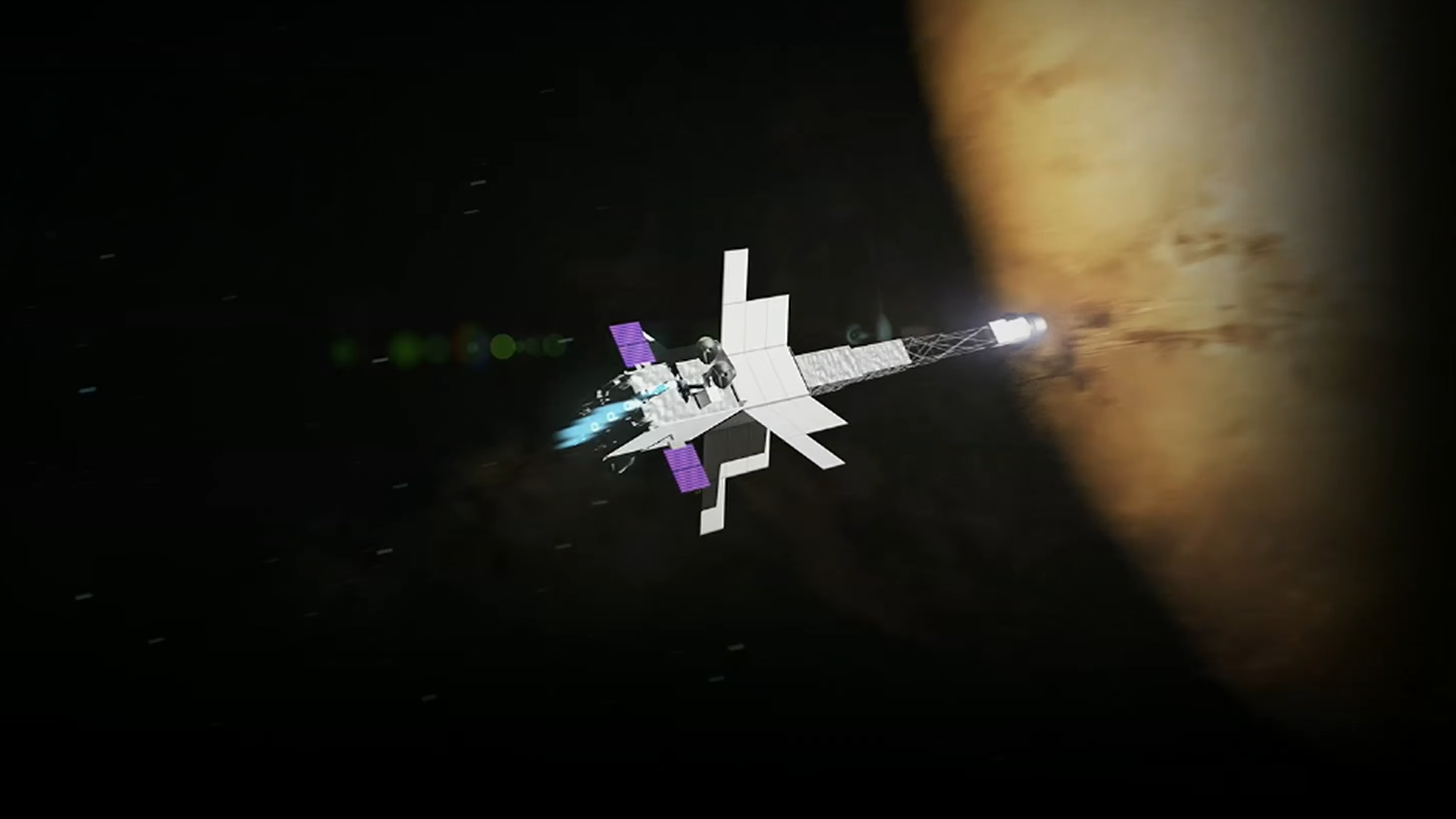
A nuclear space probe, “SR-1 Freedom,” is an ambitious but conservatively engineered nuclear–electric spacecraft that will launch during the December 2028 transfer window to Mars. Echoing Admiral Rickover’s use of ‘70% solutions to create successful first programs,’ Freedom is designed with a short and simple set of mission objectives. First and foremost, the spacecraft will demonstrate nuclear electric propulsion. After being released in an Earth escape trajectory, it will turn on the reactor around 48 hours after launch.

The mission is designed to fly on a short schedule, leverage existing hardware and deliver a relevant scientific payload to Mars. The intent of the program is to help grow and extend NASA’s developmental and operational knowledge of nuclear-powered spacecraft to finally bring to fruition 60 years of effort after multiple failed programs that in hindsight were too ambitious and too nebulous to deliver a flight program. To help deliver this project successfully, NASA is collaborating with the Department of Energy and the Department of War to develop the spacecraft’s 20-kilowatt electrical-class reactor. Ground based systems engineering, representative engineering efforts for the radiator, and other ground-based efforts, have significantly bought down technical and scheduling risks for this part of the program. The biggest remaining hurdle is integrating everything into a single package with a Brayton cycle generator to turn the reactor’s heat into electricity and propulsion.
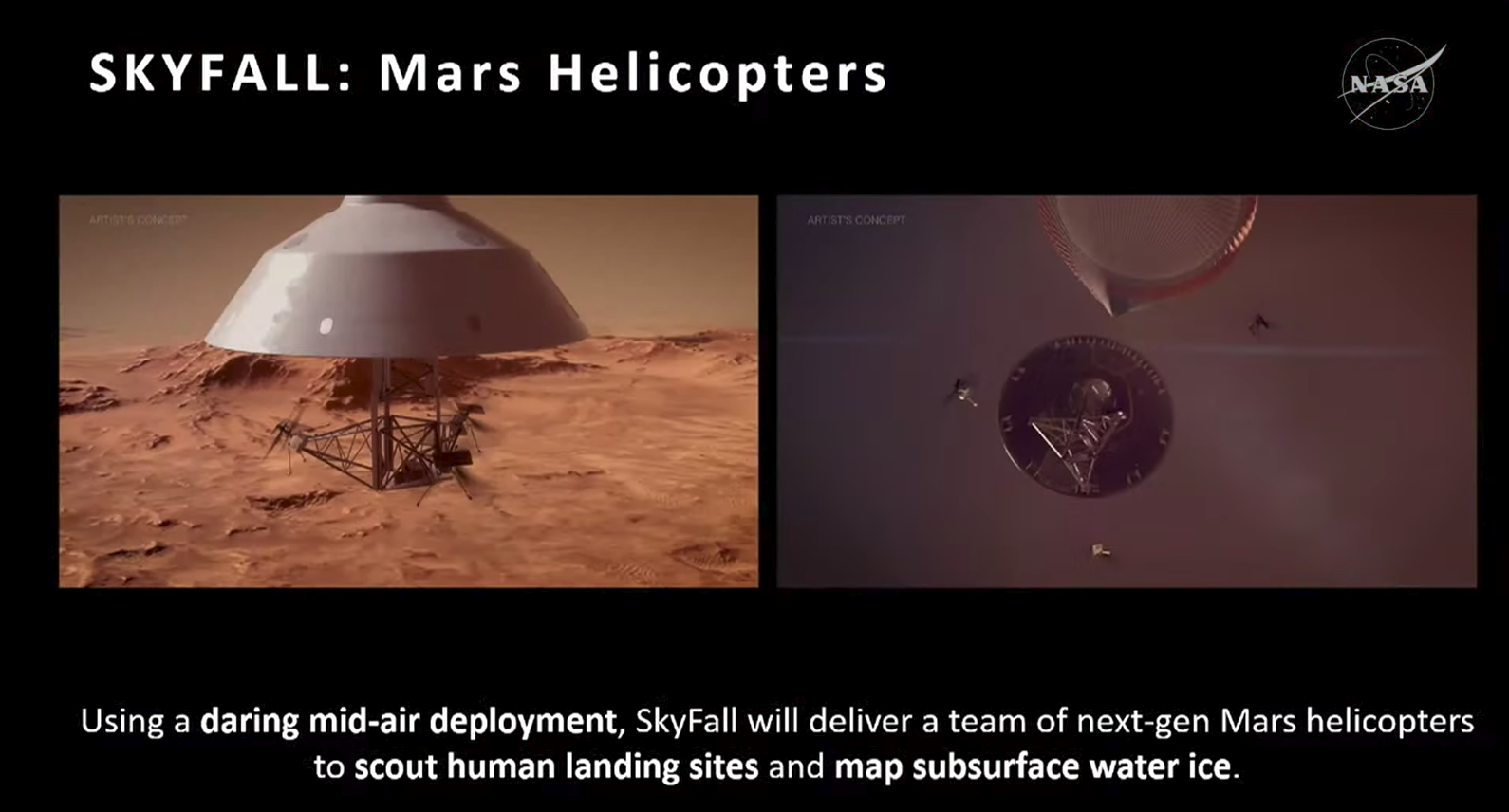
The SR-1 probe will be carrying the “Skyfall” mission to Mars, which consists of a trio of air-dropped helicopters similar to Ingenuity, which accompanied the Perseverance Rover. These three helicopters will scout the Martian surface using synthetic aperture radar to probe beneath the surface for water ice deposits.
These ambitious programs require significant funding, and making them a reality requires a reevaluation of existing programs to determine which funds can be reallocated, and which programs can be put on hold or discontinued.
With the International Space Station growing ever closer to being decommissioned, NASA has been directed by Congress to develop a plan to replace the station, with at least two providers, to reduce risk and ensure a diverse supply base. However, the current budget is insufficient to fund a new, separate space station, while still maintaining the existing ISS for the next four to six years. NASA had hoped that commercial partnerships and space tourism would produce enough revenue to cover the costs, but that hasn’t materialized. So, NASA’s intention is to add new commercial modules to the ISS, introducing full redundancy to every existing system, then, once the station’s extension has been completed to the point of being self-sufficient, it can separate from the ISS, becoming its own, new, commercial space station, allowing the ISS to be deorbited while still maintaining an American presence in low Earth orbit.

Likewise, NASA’s science programs are some of the agency’s greatest highlights, and there are many programs that the agency wishes to begin but doesn’t have the authorization or budget to perform. The wish list includes a follow-up planetary defense mission to the Double Asteroid Redirect Test (DART) to develop a contingency that can be executed on demand in the event that a large asteroid may possibly impact the Earth or Moon. NASA would also like to develop a probe to explore Uranus, with the outer planets last being visited by the Voyager 2 spacecraft. An interstellar probe, designed to study the space environment past the heliopause, is also desired by the NASA science directorate. Other missions such as Venus probes and several smaller technology programs have also had funding and authorization shortfalls.

NASA is exploring ways to potentially meet these budgetary shortfalls, and is seeking collaborative partnerships with private philanthropy groups, universities, and private enterprises to figure out how to transform the agency’s visions and goals into mission plans and hardware. Numerous requests for application and requests for information are being filed with business and academia, and NASA welcomes input through new mailing addresses in their search for new processes, payloads, and improvements to bring America back to the moon to stay.
It’s an exciting time that has rarely been seen before with America’s space programs. With organizational changes, a newfound willingness to cut what isn’t working and fix what’s broken, and ambitious, well scoped programs that are more than an ambiguous sales pitch hoping for funding, NASA is well poised to advance the state of spaceflight, and we can’t wait to see what’s next.
0 Comments