

Falcon Heavy Launches NASA’s Nancy Grace Roman SpaceTelescope


Falcon Heavy Launches NASA’s Nancy Grace Roman Space Telescope
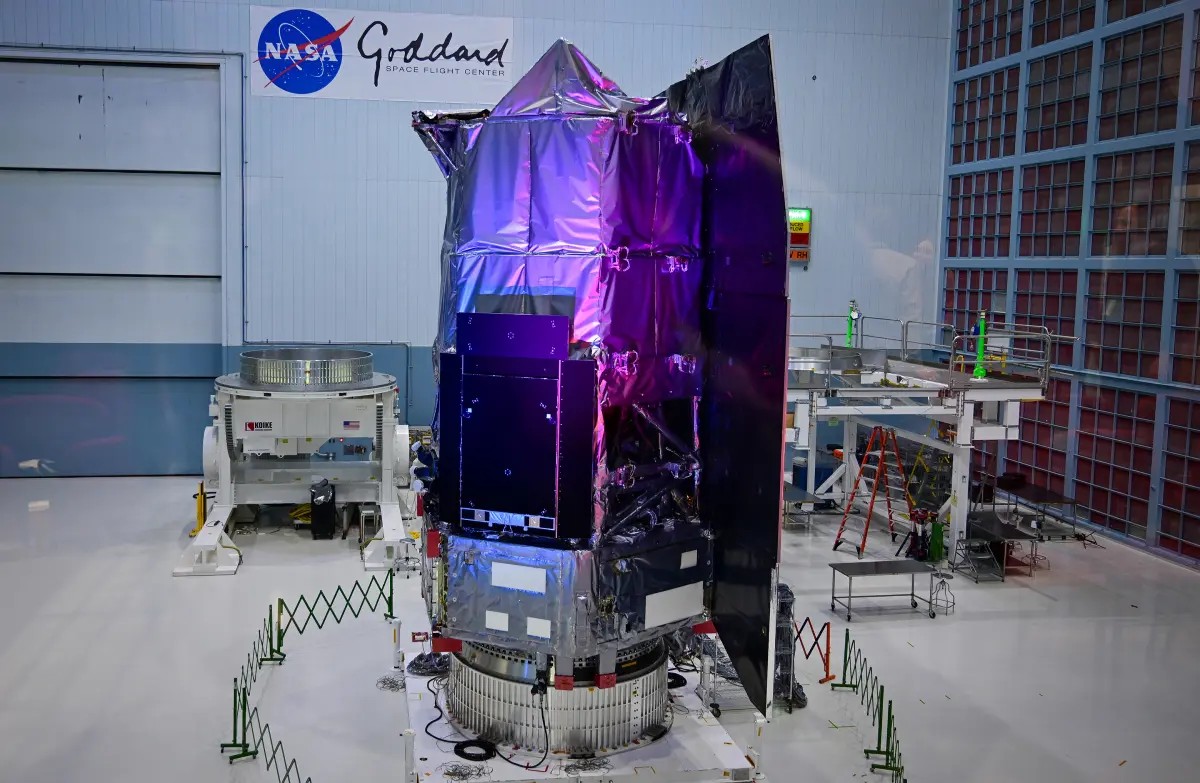
SpaceX successfully launched NASA’s Nancy Grace Roman Space Telescope Sunday morning, beginning a mission that could significantly expand astronomers’ understanding of dark energy, dark matter, exoplanets, and the evolution of the universe.
A Falcon Heavy lifted off from Launch Complex 39A at Kennedy Space Center at 7:26 a.m. EDT on August 30, 2026, sending Roman on its journey toward an operational orbit around the Sun-Earth L2 Lagrange point, approximately one million miles from Earth.
Named after Nancy Grace Roman, NASA’s first chief astronomer, the observatory is designed to provide Hubble-like image quality while viewing a dramatically larger portion of the sky.
Roman’s primary instrument, the 300-megapixel Wide Field Instrument, will provide a field of view at least 100 times greater than Hubble’s infrared instrument. This will allow Roman to survey enormous areas of the universe far more quickly while maintaining the high-resolution imagery needed to study distant galaxies, stars, and other objects.
One of Roman’s primary science objectives will be investigating dark energy, the mysterious phenomenon believed to be driving the accelerating expansion of the universe. By observing enormous numbers of galaxies and supernovae across different periods of cosmic history, astronomers hope to better understand how the expansion of the universe has changed over billions of years.
Roman will also study dark matter by mapping its distribution throughout the universe. Although dark matter cannot be directly observed, its gravitational effects can be measured, allowing scientists to investigate how it has influenced the formation and structure of galaxies and large-scale structures throughout the cosmos.
The telescope will also become a powerful exoplanet hunter. Roman will conduct large surveys of the Milky Way using gravitational microlensing, a technique capable of detecting planets that can be difficult or impossible to find using other methods.
Roman also carries a Coronagraph Instrument, which will demonstrate advanced technology designed to block the overwhelming glare of a star so that much fainter planets orbiting nearby can be directly observed. The technology could help pave the way for future space telescopes capable of directly imaging and studying Earth-like worlds around other stars.
Adopt a Pixel of the Universe
NASA is also giving the public a unique opportunity to become part of the Roman mission through its new “Adopt a Pixel” program.
Participants can claim one of the pixels associated with Roman’s Wide Field Instrument and receive a personalized certificate containing their assigned pixel number. When Roman begins returning its first imagery, each pixel will represent a tiny portion of the cosmos being observed at Roman’s extraordinary resolution, giving participants their own small connection to the telescope’s view of the universe.
NASA allows one pixel assignment per email address, with the email address also being used to retrieve the assigned pixel later. Participants can download or print a certificate displaying their pixel number and share their participation online.
The public can claim a pixel through NASA’s official Nancy Grace Roman Space Telescope website:
Adopt a Pixel with NASA:
https://science.nasa.gov/mission/roman-space-telescope/adopt-a-pixel/
Following its journey to L2, Roman will undergo a period of checkout and calibration before beginning full science operations.
Its planned five-year primary mission will survey billions of galaxies, stars, and planetary systems, producing an unprecedented panoramic view of the infrared universe while attempting to answer some of the biggest remaining questions in modern astronomy.
Roman is also designed to support an additional five-year extended mission if spacecraft resources and operating conditions allow.
0 Comments