

Curiosity Reaches 5,000 Sols on Mars as 14-Year Mission Keeps Climbing


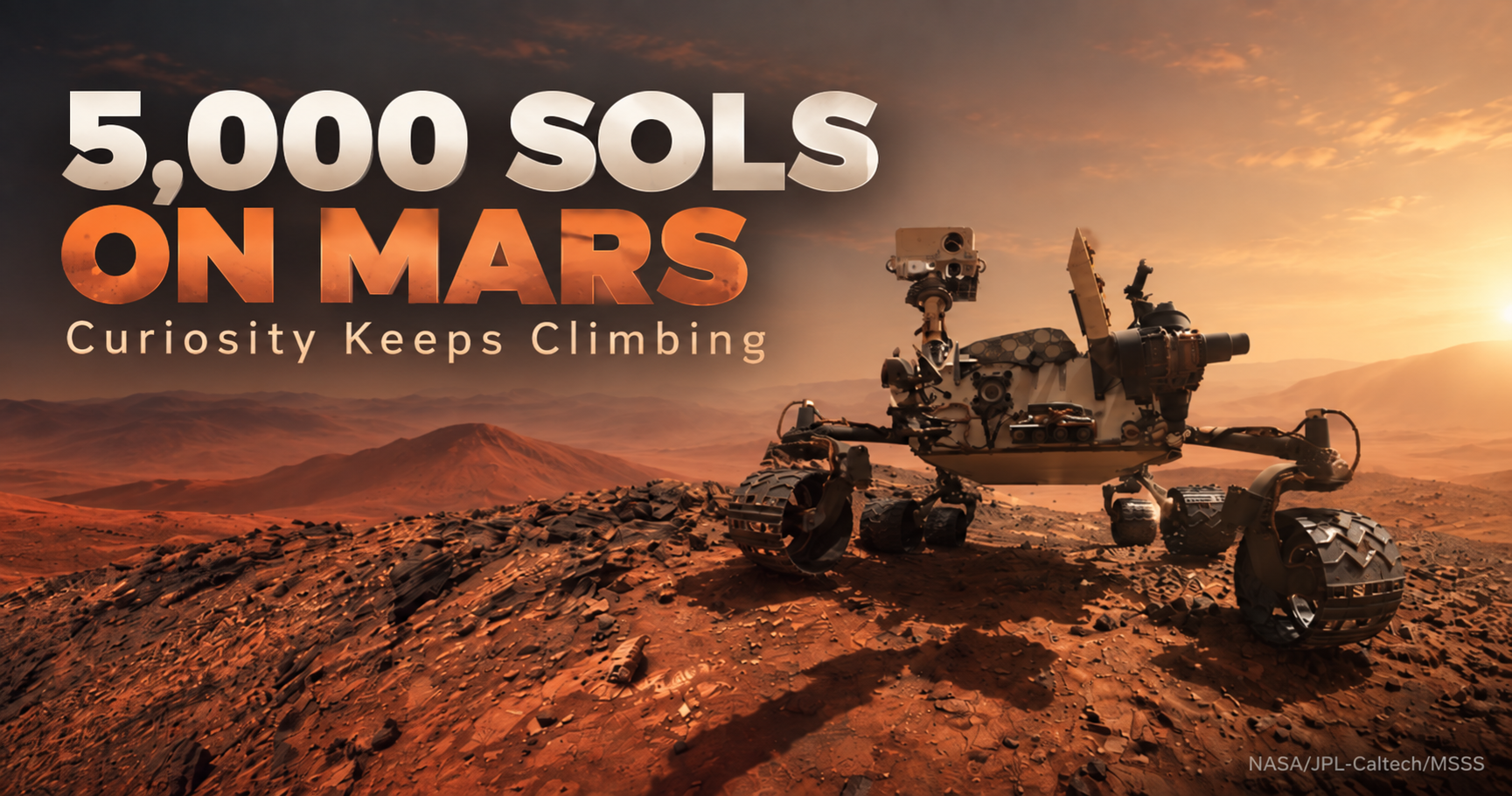
NASA’s Curiosity rover has reached another remarkable milestone on Mars, completing 5,000 Martian days of operations while continuing its climb up the slopes of Mount Sharp more than 14 years after landing.
NASA announced the milestone on September 9, confirming that August 29 marked 5,000 Martian days, or sols, since Curiosity arrived inside Gale Crater in 2012. Because a Martian day lasts about 24 hours and 39 minutes, those 5,000 sols represent more than 5,137 Earth days of surface operations.
The milestone comes as Curiosity remains actively exploring terrain that the rover was originally sent to investigate more than a decade ago — layers of Martian rock that preserve a record of how the planet’s environment changed over billions of years.
Fourteen Years and Still Exploring
Curiosity landed in Gale Crater on August 5, 2012 Pacific time, or August 6 UTC, as part of NASA’s Mars Science Laboratory mission.
The rover’s original prime mission was expected to last roughly two Earth years. Its primary goal was to determine whether Mars ever possessed environmental conditions capable of supporting microbial life.
Early in the mission, Curiosity found chemical and mineral evidence showing that parts of Gale Crater once contained environments that could have been habitable. The rover has continued building on those discoveries by examining progressively younger layers of rock as it climbs Mount Sharp.
More than 14 years later, Curiosity remains an active science mission.
Curiosity Climbs One Kilometer Above Its Landing Site
Sol 5,000 is not the rover’s only major recent milestone.
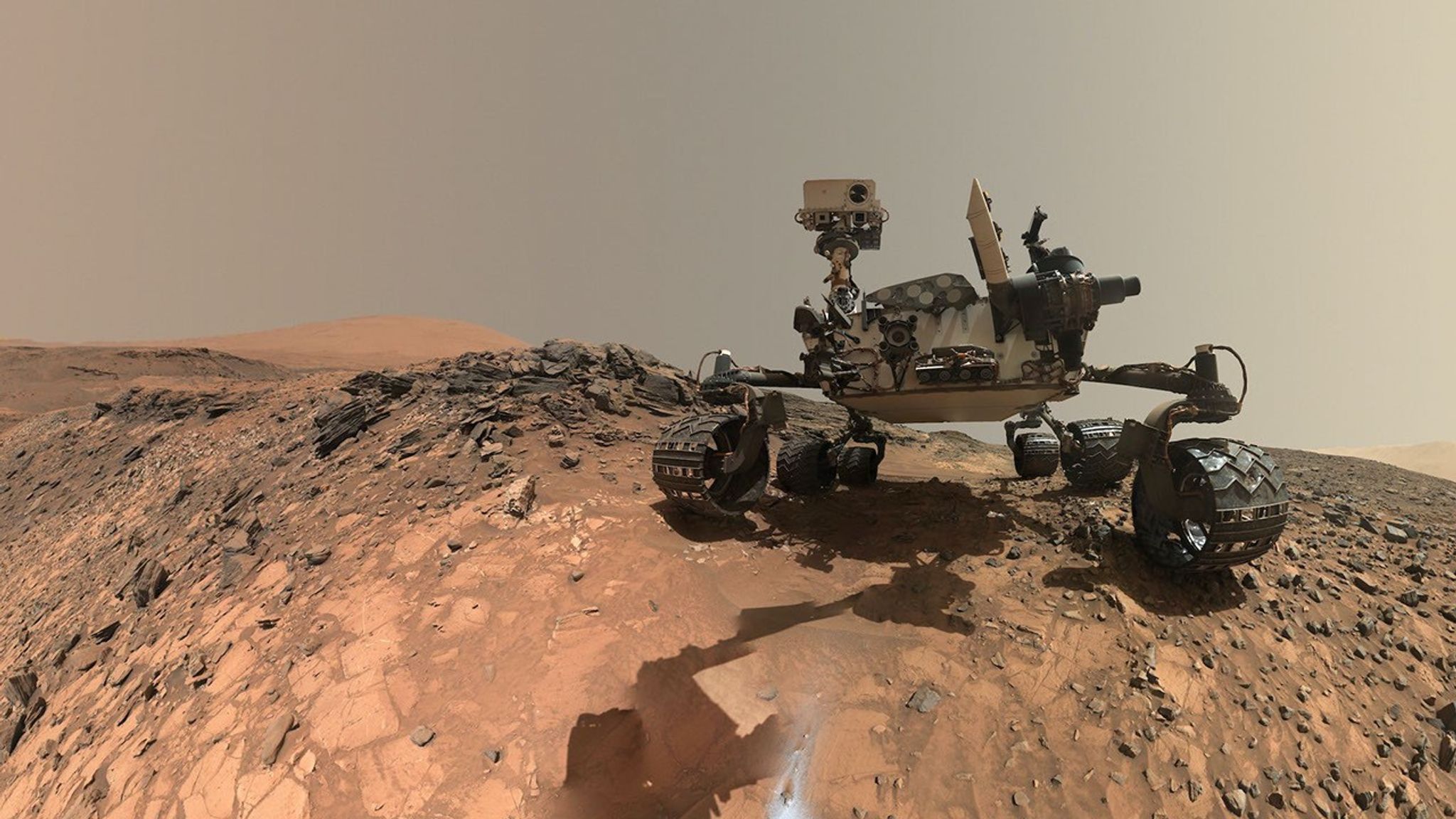
On August 26, NASA announced that Curiosity had climbed more than 1 kilometer — about 3,281 feet — in elevation above its original landing location on the floor of Gale Crater.
Curiosity has been climbing the lower slopes of Mount Sharp since 2014. The mountain rises roughly 5 kilometers above Gale Crater and contains layer after layer of sedimentary material that scientists can use to reconstruct portions of Mars’ environmental history.
For comparison, NASA’s Spirit rover climbed approximately 106 meters, or 348 feet, from its landing site to the summit of Husband Hill during its exploration of Gusev Crater.
Curiosity has now climbed nearly ten times that amount.
NASA recently released a massive 323-image panorama looking back down the side of Mount Sharp from Curiosity’s position in a broad valley known as Valle Grande. The rover’s tracks can be seen stretching away toward the distant floor and rim of Gale Crater through the dusty Martian atmosphere.
Digging Into “Chocolatal”
Curiosity did not stop working to celebrate Sol 5,000.
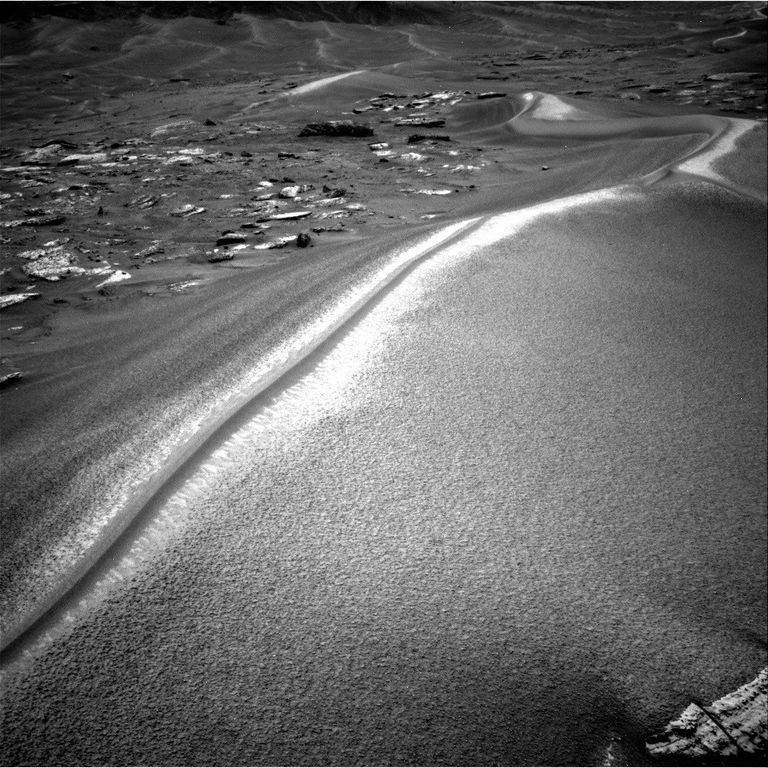
The rover is currently studying a large, narrow, wind-formed ripple that mission scientists have named “Chocolatal.”
Scientists believe the feature could be a type of Martian landform known as a transverse aeolian ridge, or TAR. These ridges are widespread across Mars and generally form perpendicular to the dominant wind direction.
Curiosity has investigated similar features before, but Chocolatal is located considerably higher on Mount Sharp. Scientists want to determine whether the grains, layers and composition of the feature differ from similar wind-formed ridges encountered at lower elevations.
To get a better look beneath the surface, mission controllers intentionally drove one of Curiosity’s wheels into the ripple before backing the rover away slightly.
The maneuver created a small trench exposing previously buried material.
Curiosity then used several of its instruments to examine the freshly exposed region.
The rover’s Mars Hand Lens Imager, or MAHLI, captured detailed images of the trench wall to look for layering and changes in grain size. Its Alpha Particle X-ray Spectrometer, or APXS, examined the composition of coarse material on the surface, while the rover’s ChemCam laser spectrometer targeted several portions of the ripple.
Mastcam and Navcam observations were also planned, including searches for dust devils and atmospheric measurements.
Curiosity even returned images taken on Sol 5,000 itself, including Mastcam, MAHLI and navigation-camera views collected during the milestone sol.
Reading Mars’ Geological History
Mount Sharp has been Curiosity’s primary destination since before the rover ever reached Mars.
The mountain consists of kilometers of layered rock deposited over enormous spans of Martian history. By traveling upward through those layers, Curiosity is effectively moving through different chapters of Mars’ geological past.
Some lower layers contain evidence associated with ancient lakes and groundwater, while higher portions of the mountain record increasingly dry conditions.
That transition is particularly important to scientists attempting to understand how Mars changed from a world that once possessed rivers, lakes and potentially habitable environments into the cold, dry planet seen today.
Curiosity recently examined another unusual geological feature interpreted as a possible erosional surface, representing a period when sediment stopped accumulating and erosion instead removed material before deposition resumed.
The rover has since returned to its primary route climbing higher on Mount Sharp.

The Next 5,000 Sols?
Curiosity has dramatically exceeded the lifetime originally envisioned for the mission.
Fourteen years of Martian dust, extreme temperature swings, radiation and thousands of kilometers of wheel rotations have taken their toll, but engineers have continually adapted how the rover operates to keep the mission productive.
Its wheels show considerable wear, certain hardware has aged, and mission planners carefully manage power and driving routes. Yet Curiosity continues to move, drill, photograph, analyze and send science data back to Earth.
NASA’s mission team summed up the Sol 5,000 milestone with an ambitious outlook: after 5,000 sols of science, the team is looking toward what the rover can accomplish next.
Few spacecraft ever operate long enough to reach such a milestone.
Curiosity arrived at Mars looking for evidence that the planet once possessed conditions suitable for microbial life.
More than 14 years later, it is still climbing — and Mars is still giving it new places to explore.
0 Comments