

Artemis II Launches to Send Humans Around the Moon


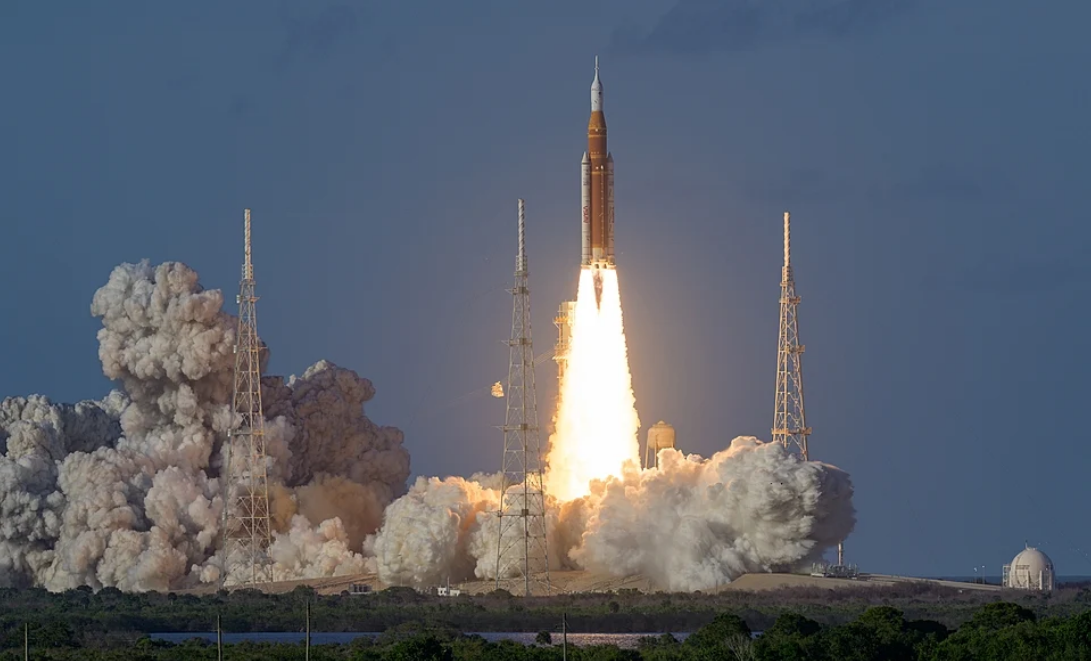
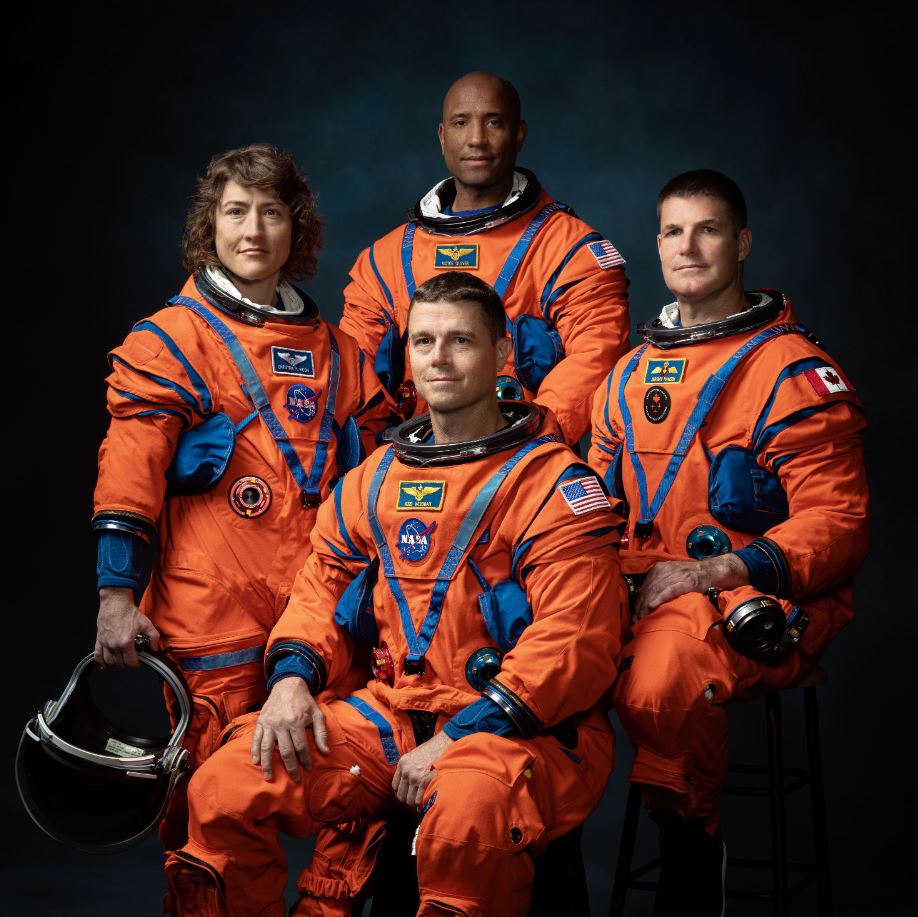
At 6:35 PM local time on Wednesday, April 1st, 2026, NASA’s historic Artemis II mission lifted off from Launch Complex 39B at the Kennedy Space Center in Florida, carrying NASA astronauts Reid Wiseman, Victor Glover, and Christina Koch, as well as Canadian Space Agency astronaut Jeremy Hansen, on a 10-day mission bound for a free-return flyby around the Moon. The four astronauts are the first crew to embark on such a mission in over 53 years, with NASA’s last crewed venture beyond Earth orbit being the Apollo 17 mission in December of 1972.
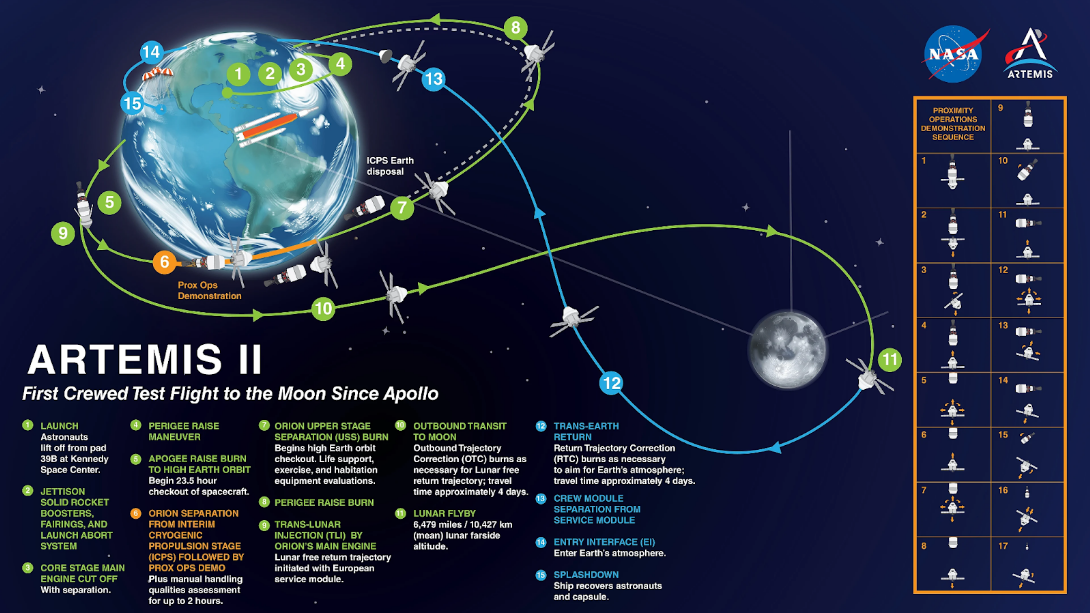
Following a largely nominal countdown, afflicted by only a couple of minor issues with the rocket’s Flight Termination System and the Orion spacecraft’s Launch Abort System batteries, which were quickly resolved by the teams in Launch Control, the SLS vehicle, producing 8.8 million pounds of thrust from two solid rocket boosters and four RS-25 core stage engines, lifted off into clear Cape Canaveral skies only 11 minutes into a 2 hour launch window. A picture-perfect ascent, booster separation, main engine cutoff, core stage separation, and solar array deployment on the Orion capsule, nicknamed “Integrity,” has led to the next phase of the mission: a 24-hour period of Earth-orbit checkouts by the crew, followed by the trans-lunar injection burn from the ESA-provided service module, sending the crew on their way to Earth’s nearest cosmic neighbor.
Artemis II doesn't seek to land on the Moon, but is instead designed to be a crewed test flight of Orion on its own. Throughout their journey, Wiseman, Glover, Koch, and Hansen will prove out critical life support, navigation, and communication systems, among others, that will be essential to accomplishing the lunar surface missions under the Artemis program, the first of which is set to take place in 2028. Many of these systems, including crucial Environmental Control and Life Support Systems (ECLSS) and docking hardware, couldn't be fully tested on the Artemis I mission in 2022 due to the lack of humans aboard that flight.
With this monumental step forward for the Artemis program comes a set of shattered spaceflight records. Notably, Pilot Victor Glover will be the first person of color to travel beyond Earth orbit. Mission Specialist Christina Koch will be the first woman to do so, and Mission Specialist Jeremy Hansen will be the first non-American to reach the moon. Additionally, it’s possible that during their flyby of the moon, the crew could reach a distance as far as 250,000 miles (400,000 km) from the Earth, exceeding the distance record set by the ill-fated Apollo 13 mission in 1970.
Re-entry, expected to occur 4 days after the lunar flyby and 10 days after launch, will be the fastest ever attempted by a crewed mission, blazing through the atmosphere at speeds of up to 25,000 miles per hour (40,000 km/h) before splashing down off the coast of San Diego, California. If all goes well, NASA will be in prime position to carry out the next giant step towards a sustained lunar presence: Testing of the landing vehicle, provided by either SpaceX or Blue Origin, or possibly both, in tandem with Orion, in Earth orbit on Artemis III in 2027. Though it’s only the beginning of the mission, there’s no doubt that the men and women from all 50 of the United States and the 3 space agencies supporting Artemis II can breathe a collective sigh of relief after a spectacular and successful launch.
NASA will continue to provide updates on the status of the Artemis II astronauts and their mission as it progresses over the coming days.
0 Comments